


Welcome to a free issue of Result Makers: the first demand design Substack for lean agency founders, solopreneurs, and consultants who dare to create a different game.
Dear Readers, Subscribers, and Lean Agency Founders Who Dare To Be Different,
Humans are wired to chase new things.
People will freeze in line overnight for a new Labubu doll.
Hours are wasted every day scrolling social media like a slot machine.
The neuroscientist Andrew Huberman puts it bluntly:
“Novelty is the number one trigger of dopamine.”
Our pull towards newness is not a moral failure: it is a biological impulse.
Every time you see a supposedly new thing, your brain does a quick scan:
Is this genuinely new? Or more of something old in a “new outfit”?
And so it goes with every prospect who sees:
Your brand
Your offers
Your services
Just like you…
Your buyers have strong filters against “new outfits” on old categories and promises.
After 5 years running a cold email studio that worked primarily with lean agencies…
I’d make a safe bet that most lean agency founders are unintentionally on the wrong side of that filter.
Most are shouting “we’re new and different” from inside an old game.
I literally was that person shouting in my previous business.
And many of my clients were that person shouting as well.
But you can take my opinion with a grain of salt.
SparkToro and AgencyAnalytics released their 2025 reports on the state of the agency world, and the data exposes a fracture hiding in plain sight:
For the 3rd year in a row, client acquisition is the top agency pain point
94% said referrals are the top source of new business
Only 14% said sales pipeline is “healthy” right now
If over 598 agencies surveyed almost all rely on referrals for new business…
14% report sales pipeline as “healthy”…
And client acquisition as a whole, year over year, is the apex struggle…
Something fundamental is broken.
It took me three years of obsession to see what I cannot unsee.
I’ve invested countless hours diving into the seminal writings of:
And I’m completely convinced that putting “new outfits” on old categories rarely works out as founders hope.
Do you know a previous power user of Google Plus?
How about a friend who would ask for a Red Bull Cola at a restaurant?
Or lastly, anyone who travelled to another city to go to a Microsoft retail store?
No, you do not.
That’s because before your:
Brand
Positioning
Messaging
Offers
Services
Marketing
Sales
Content
Copy
Is your Category.
And in every category, there are leaders and followers.
Research from the team at Play Bigger unearthed this shocking fact:
Category kings capture 76% of total market value.
Everyone else fights for the remaining 24%.
In the agency world…
The real fracture in the foundation is not the #1 challenge of client acquisition.
It isn’t even the discrepancy between 94% depending on referrals and only 14% reporting a “healthy” sales pipeline.
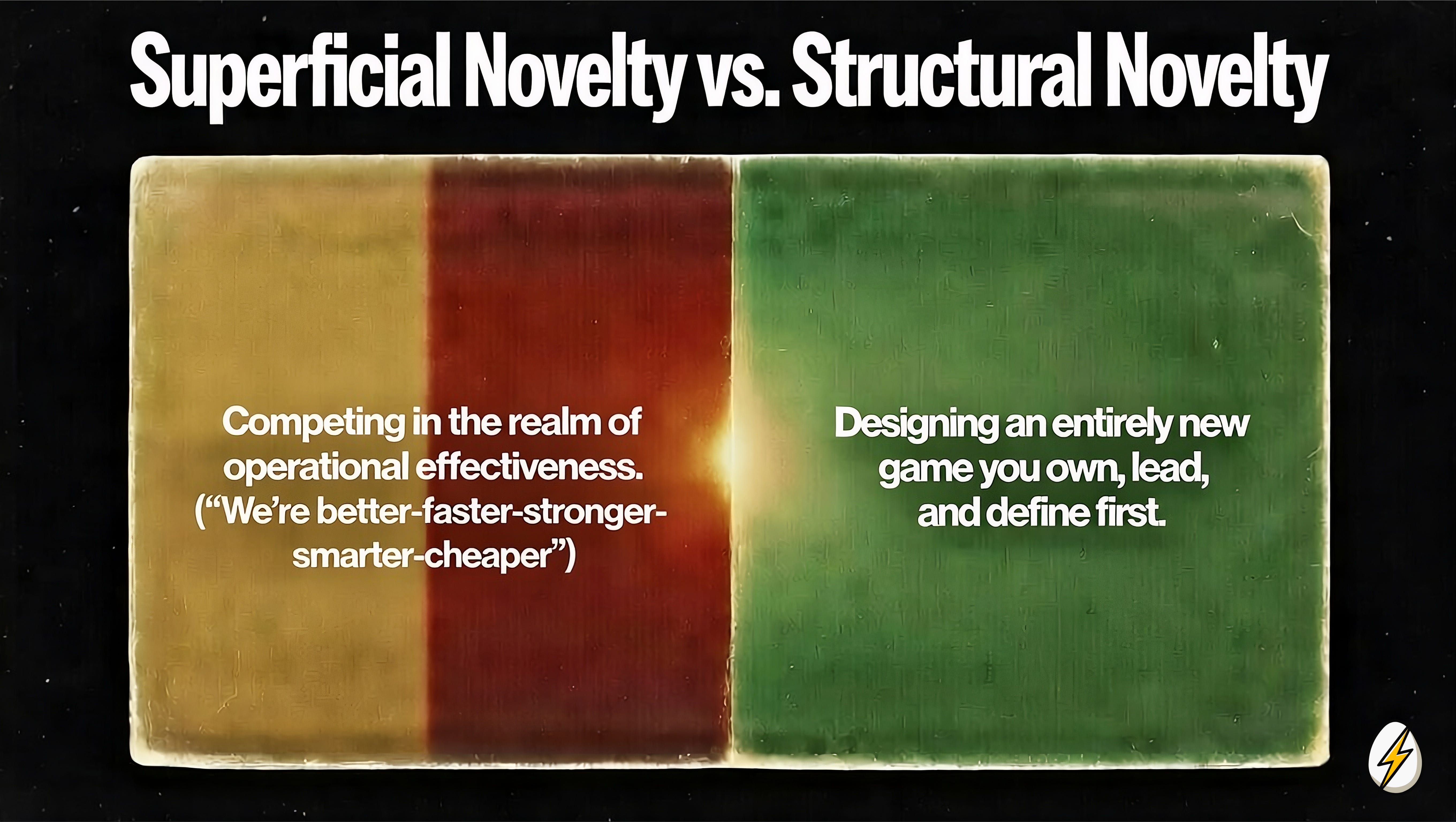
The distortion in the field comes down to Superficial Novelty vs. Structural Novelty.
Superficial Novelty vs. Structural Novelty: Every Lean Agency Founder Is Either Stuck In Someone Else’s Game Or Creating Their Own
In the early 1990s, Pepsi tried to surf the “clear craze” with Crystal Pepsi.
They packaged up a transparent cola in a clear bottle.
Nothing about it solved a new problem.
No new category was defined.
No clear, different, must-have benefit.
It was the same sweet, fizzy cola experience in a “new outfit”.
A huge Super Bowl launch spiked the curiosity of cola drinkers with the slogan:
“YOU’VE NEVER SEEN A TASTE LIKE THIS.”
In reality, it tasted slightly off Pepsi, packaged as “new,” “pure,” and “healthy.”
And repeat purchases fell of a cliff once people realized….

Crystal Pepsi was Superficial Novelty without a new game.
It changed the look (clear) without changing the logic (still just another cola).
There was:
No new problem space
No new identity
No new ritual
Just a visual gimmick layered on top of an existing category.
Novelty was only surface-level.
Pepsi burned money on awareness.
Curiosity simmered down.
Demand collapsed.
It was a clear case of a lack of Structural Novelty.
And it’s remembered as one of the biggest product flops in beverage history.
Let’s jump forward to 2011, when Dave Asprey launched Bulletproof Coffee.
He didn’t spin up an old category with a “new outfit”.
He reframed the morning cup of Joe from a generic stimulant into a ritual for cognitive performance.
Coffee became “performance fuel”.
And the “functional coffee” subcategory was born.

Bulletproof Coffee was Structural Novelty: an entirely different game.
Dave spotted a Problem-Space Gap.
Thousands of people obsessed with performance and health drank coffee.
But no one was addressing:
Toxins
Brain fog
Crash-free focus
So Dave created the new mental bucket of “functional coffee,” inspired by the yak butter tea he enjoyed while trekking in Tibet.
Then he defined a Novel Point of View (POV):
“Functional coffee” gives you clean energy, sharper cognition, and metabolic benefits—not just a caffeine buzz.
His content, books, and products all reinforced the same story.
He commanded premium pricing.
And the biohacking movement exploded.
Now, multiple brands compete in the subcategory he created.
Superficial Novelty is competing in old categories in the realm of “better-faster-stronger-smarter-cheaper”. Structural Novelty is when you create a new game you own, lead, and define first.
Most lean agency founders won’t invent a new macro category such as “Coffee”.
But you can become the default choice in a microcategory you create.
This is where you step into Structural Novelty and become a Result Maker.
The Diffusion Zone: Where Lean Agencies Fight To Be “Better” and Compete To Be Forgotten
“You can’t be all things to all people and still have a powerful position.”
— Al Ries & Jack Trout
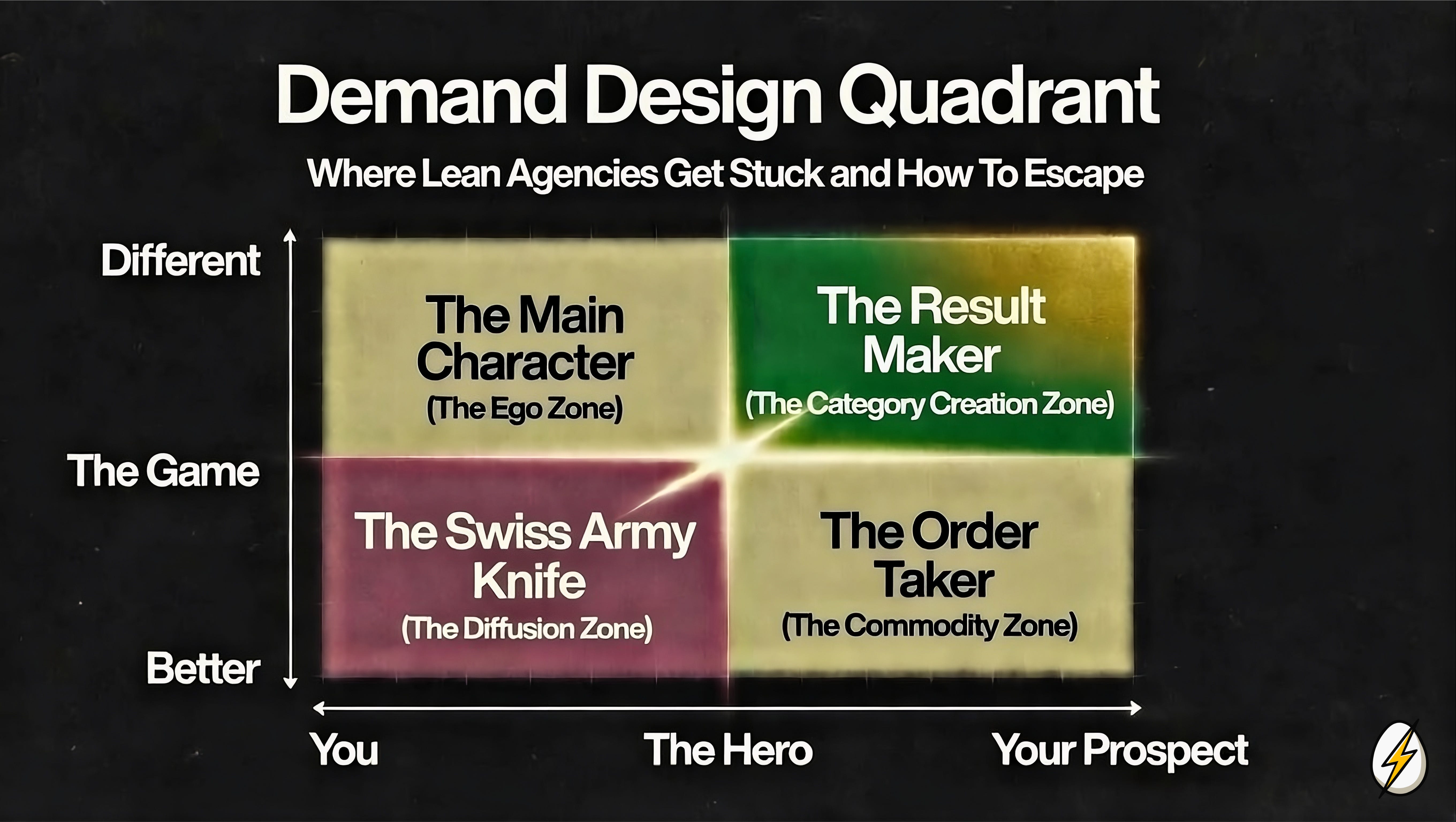
I created the Demand Design Quadrant to visualize four common lean agency archetypes I’ve seen across 40+ consulting engagements and hundreds of sales calls with founders, from solopreneurs to teams of 25.
I’m still fleshing these concepts out, but what I’ve found is this:
Superficial Novelty is deceiving our beloved agency space.
This must be brought into the light at multiple angles for you to see clearly.
The main culprit behind client acquisition struggles, referral dependency, and average to unhealthy pipelines is:
Not the economy
Not the competition
Not your skills or execution
Take a look at the Demand Design Quadrant once more.
Let’s break down each archetype—and which ones quietly sabotage your pipeline.
The Swiss Army Knife (The Diffusion Zone)
Most lean agencies live in The Diffusion Zone by default.
Here, you try to be everything for everyone and end up strategic for no one.
Focus scatters across too many services, industries, and client types.
Energy spreads so thin that your signal becomes noise.
“Operational effectiveness” is the grounds of competition.
Your messaging centers around “We’re better-faster-stronger-smarter-cheaper”:
Your brand as the hero
Your solutions as the best option
Your service delivery and how much clients “love you”
Warm referrals and word-of-mouth leads close occasionally.
Cold prospects can’t tell what makes you different from the 50+ other agencies selling the same thing.
Relationship Momentum and the pre-built trust of referrals drive revenue, but uncertainty around client acquisition never really goes away.
Converting leads through ads, content creation, and cold outreach is a bloody fight.
And just as a Swiss Army Knife, you’re useful.
Just easy to replace.
The Order Taker (The Commodity Zone)
The Commodity Zone is when your agency stops being the hero and starts being the guide in your messaging.
You make the prospect the center of your story.
You articulate their problems with deep understanding.
Your brand, solutions, and “exceptional customer service” take a backseat.
You’ve applied the 80/20 Pareto Principle—doubled down on your core genius (the 20% that drives 80% of revenue).
You’re no longer a scattered signal. But you’re still stuck in Vendor Comparison:
You’re viewed as a pair of skilled hands, not a strategic mind
You’re seen as one vendor among 50+ other agencies saying the same thing
Your signal is stronger than The Swiss Army Knife, but not categorically different
It’s frustrating because you deliver great results.
But you fight in the realm of “operational effectiveness” (price, speed, etc.), solving obvious problems with obvious solutions your clients can find elsewhere.
Warm referrals close.
Converting strangers into clients remains an uphill battle.
And you end up treated as The Order Taker, not an irreplaceable strategic partner.
The Main Character (The Ego Zone)
When you enter the Ego Zone, you’ve escaped the Vendor Comparison trap.
You’ve niched down the services you sell and the people you sell them to.
You’ve stopped trying to be “better” and built something genuinely different.
You own a unique idea, approach, or methodology.
But you’ve fallen back into making yourself the hero of your story.
Your messaging highlights:
What you offer
What you believe
Your brand’s brilliance
Your innovative process
Your awards, case studies, and testimonials
The problem?
You understand your target market’s problems, but haven’t reframed them in a way that changes how they see the world.
Your difference was built on hunches and what clients told you they wanted.
Not on a Problem-Space Gap you systematically designed and own.
What’s missing is the foundational work:
Synthesis of client confessions, market discussions, and industry studies
Claiming “new game” territory anchored on a non-consensus insight
Reframing an obvious problem or surfacing a non-obvious one
Identifying the strategic enemy
Naming a microcategory
You created a unique offer.
Your solution is custom-built.
But your messaging has nowhere to point except back to you.
And this is the disconnection that strangers feel.
Warm referrals close.
Cold prospects don’t see themselves in your story.
You are differentiated, but…
You haven’t named an entirely new game with your client as the hero.
It’s the paradox of The Main Character: The more you focus on what makes you unique, the less your prospects see themselves in it.
And you end up known for what you built, not what your clients become.
The Result Maker (The Category Creation Zone)
The Category Creation Zone is where you stop competing and start designing demand.
You’ve done the foundational work to escape the other three zones.
You’ve synthesized client confessions, market discussions, and industry studies to uncover a non-consensus insight.
You’ve reframed an obvious problem or surfaced a non-obvious one.
You’ve named the strategic enemy (the villain keeping them stuck).
You’ve articulated a Novel POV.
You’ve claimed a microcategory no one else owns.
And you’ve given your prospects a new way to see the world.
Your messaging doesn’t center around:
How great you are
How skilled your execution is
How different your process is
It centers around your client as the hero of the story:
Escaping the Problem-Space Gap you defined
Attaining the Game-Changing Outcome your microcategory delivers
Your positioning is customer-problem-obsessed, not self-focused.
You’re not competing on “better-faster-stronger-smarter-cheaper.”
You created an entirely different game.
Warm referrals close.
Cold strangers convert to buyers.
Your signal is sharp, your microcategory is clear, and your messaging reframes what your prospects should care about.
You’re not one option among many.
You’re not fighting for attention in a crowded space.
You’re the only logical choice in a microcategory you own.
As The Result Maker, you’re not treated as another vendor, executor, or talented founder with a cool idea.
You’re hired to lead your client into a different future they couldn’t see before—because you designed a microcategory that reframes how they think.
Unlock Structural Novelty: One Upstream System To Design Demand Instead of Chasing It
Dear reader, no amount of “better” messaging, execution, or effort fixes Superficial Novelty.
As mentioned earlier, from Play Bigger’s groundbreaking research:
Category kings capture 76% of total market value.
Everyone else fights for the remaining 24%.
But even so…
Most lean agency founders assume they have to capture demand within an existing category.
That single assumption is exactly what traps most lean agencies in Vendor Comparison, selling commodity services with an average or unhealthy pipeline.
Demand Design rejects that premise entirely with a different path.
I believe it is the single most important meta-skill cluster for lean agency founders to cultivate in 2026 and beyond.
I coined the term after obsessing over 100+ Category Pirates’ articles, 16 books on category design, discussion notes from 40+ consulting engagements, X-ray searches through lean agency discussions on Reddit and Quora, and 2024-2025 industry reports from SparkToro and AgencyAnalytics.
It isn’t a fly-by-night tactic.
It isn’t a channel.
It isn’t another framework to “try”.
And it’s not a task to check off the to-do list.
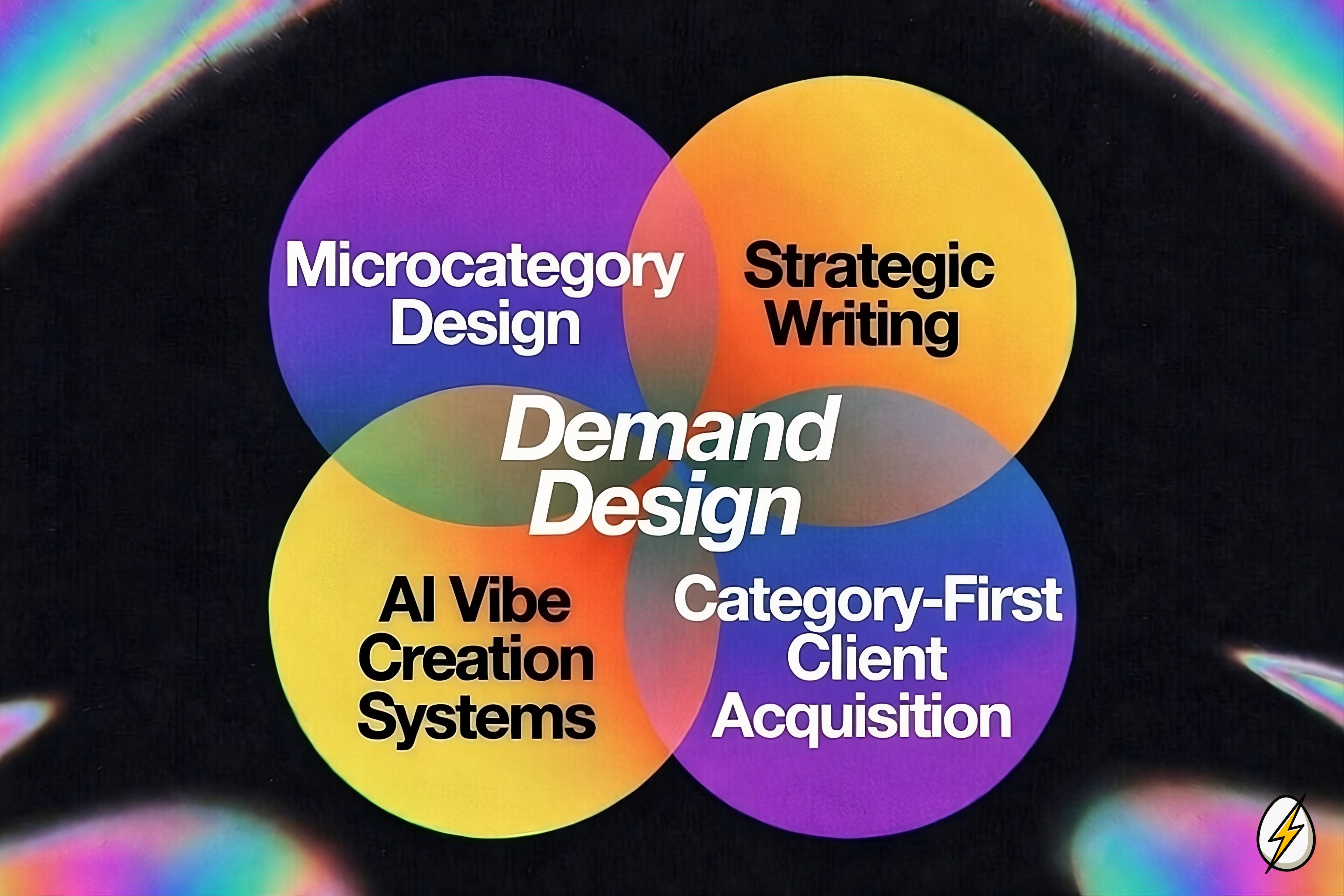
Demand Design is a meta-skill cluster that operates as your upstream foundation, making all downstream marketing and sales exponentially more effective.
It rejects competing in existing categories based on better execution, faster delivery, stronger case studies, smarter tactics, and cheaper pricing.
It actually has nothing to do with being “better” at all.
Instead, it creates defensible microcategories, articulates problem spaces, and develops novel POVs that make traditional comparison irrelevant.
Demand Design asks a single question: “What is the Problem-Space Gap we can solve in an entirely different game we define first?”
All downstream tactics become exponentially more effective because you exist in a differentiated microcategory rather than crowded niches dominated by others.
At the core, it empowers lean agencies to escape Vendor Comparison—not by being better, but by building on a structurally different foundation.
Here’s what that looks like:
Without Demand Design (What Most Agencies Do):
Build lead magnets that teach tactics, not a Novel POV
Write content that sounds like every agency on LinkedIn
Compete on being “better-faster-stronger-smarter-cheaper”
Assume you have to find “product/market fit” in an existing category
Rely on referrals because cold leads don’t see what makes you different
Treat positioning as an afterthought inside crowded niches others dominate
Chase demand from prospects comparing you to anyone selling similar services
Optimize messaging, offers, outreach, and content strategy, only to face the same client acquisition struggles year over year
With Demand Design (What Result Makers Do):
Take ownership of a defensible microcategory you create
Articulate a real Problem-Space Gap nobody else has named
Make your client the hero, not your brand, solutions, or service delivery
Convert cold leads into warm leads who see you’re playing a different game
Build lead magnets that teach your microcategory, not tactics everyone teaches
Root all marketing, sales, and operations strategy in demand design, so everything downstream amplifies
Write category-defining content from a Novel POV so aligned with your prime future clients that believers evangelize it
Create “category/market fit” in a new game you lead instead of chasing “product/market fit” in crowded niches you don’t
Orchestrate your messaging, offers, outreach, and content around one clear problem-space you own so your authority compounds
Now let’s break down each of the four meta-skills, which become a chain reaction when wired together.
Meta-Skill 1: Microcategory Design
Microcategory design lets you escape crowded niches and design an entirely new playing field you own.
You move from Superficial Novelty to Structural Novelty—becoming structurally different at a foundational level.
Most lean agency founders won’t create big categories like “Coffee” or “Ride-Sharing.”
But you can own a defensible microcategory.
You do this by finding a Problem-Space Gap no one else has articulated in a familiar category.
It starts with an obsessive problem insight.
Not hunches. Not surface symptoms. Not what clients say they want.
You’re looking for a “distortion in thinking” where reality doesn’t match what your market believes.
This will show up in two ways:
A known problem you will reframe in a new, different, and non-obvious way
A problem you’ll bring to light that your target market doesn’t know exists yet
Where do you find the Problem-Space Gap?
You synthesize three sources of pains, desires, obstacles, and common beliefs:
Client confessions — the unfiltered things they actually say in sales calls
Market discussions — what the industry talks about (podcasts, articles, social media, Reddit, Quora)
Data signals — what’s actually happening vs. what everyone says is happening (industry research studies and reports)
Then you ask these core questions:
“Where’s the gap between what the market says it wants and what it needs?”
“What problem has no one framed in a microcategory yet?”
“Where does reality not match what people believe?”
“What’s the microcategory only I can own?”
Once you find the Problem-Space Gap, you can develop your Novel POV.
This is your microcategory opportunity.
Meta-Skill 2: Strategic Writing
Once you design your microcategory, you need to talk about it everywhere.
Most agencies struggle with messy messaging.
Their internal communications, sales copy, and online content all sound different.
The result? Messaging chaos.
Demand Design fixes this with a consistent “throughline”: your defensible microcategory.
Strategic writing isn’t about creating more content for content’s sake.
It’s a meta-skill that uses copywriting and ghostwriting principles to encode your defensible microcategory into every piece of content you create.
Every social post reinforces the microcategory.
Every newsletter educates on the problem space you own.
Every piece of copy positions the new game you lead and define first.
Your writing shifts from, “Here’s what we do and why we’re great.”
To, “This is the new problem space. This is why it matters. This is how YOU are the hero of the microcategory I own.”
Your prospects will stop asking themselves, “How are you different?”
They’ll start saying, “You’re onto something I haven’t seen before.”
Strategic writing does four things simultaneously:
Conditions readers on the Problem-Space Gap and your microcategory
Builds authority and trust
Reframes thinking
Compels action
Every piece says the same thing in different ways:
“This is why the old game is broken.”
“This is why the microcategory matters.”
“This is why you need to think differently.”
And when you do this consistently?
Your content compounds.
Each piece builds on the last.
Authority stacks.
Warm inbound becomes inevitable.
Meta-Skill 3: AI Vibe Creation Systems
Staying consistent in what you say, where you say it, and how often you say it is hard.
You design the microcategory.
You articulate it through strategic writing.
You write a few pieces of content.
Then you wonder:
“How can I scale our microcategory message without hiring a dedicated team?”
Most lean agencies can’t afford to hire separate specialists for visual identity, brand voice, copywriting, and content creation.
Building a team with the time, skills, and coordinated effort to get your microcategory message spread with perfect consistency is tricky.
So most lean agencies try to scale on being “better-faster-stronger-smarter-cheaper”.
Demand Design solves this with AI vibe creation systems.
AI vibe creation systems encode your microcategory into master prompts.
You systemize:
Visual assets (AI image generation in your color scheme and design style)
Brand voice (tone, vocabulary, sentence structure)
Category language (your custom terminology and POV)
Content frameworks (various frames to express your POV)
With master prompts and AI project files, one person can outline copy and content for ads, warm emails, cold emails, blog posts, social media posts, newsletter content, sales pages, landing pages, lead magnets, video scripts, sales scripts, phone scripts, case studies, and white papers.
One person can manage everything.
Any team member could jump in when needed.
All maintaining perfect consistency.
All reinforcing the same microcategory.
All in your voice, your microcategory language, your vibe.
No dedicated team of specialists required.
No loss of signal as your microcategory grows.
Your microcategory message becomes reproducible, scalable, and consistent.
Every day. Every channel. Every communication.
Without dilution.
Meta-Skill 4: Category-Defining Client Acquisition
Lean agencies often assume the prospect understands the real problem.
But usually, they just want their symptoms to go away.
“We need more leads!”
“We need more customers!”
“We need to raise our prices!”
Demand Design views client acquisition as the frontline of microcategory teaching.
Instead of pitching services, you give them a new way to see the world.
You surface a non-obvious problem or reframe an obvious one in the “old game”.
You name the strategic enemy.
You define your microcategory story (your Novel POV).
Every aspect of client acquisition is a gateway to your microcategory:
Ads point out the problem-space gap in the old game
Lead magnets teach the problem-space gap and how to escape
Cold outreach shows why the old way fails and introduces the new game
Organic content builds curiosity in your microcategory through consistent language, narrative, and your Novel POV
Email marketing transforms subscribers into a warm pipeline of microcategory believers
Sales calls provide deep microcategory understanding, so prospects move from curious to committed clients
Word-of-mouth makes your message so repeatable that believers evangelize it unprompted
When a prospect consumes your content, lead magnets, and emails, they become believers in the microcategory you own.
When they finally book a call, they’re not asking, “How are you different?”
They’re saying, “I’ve been reading your stuff. How does this work?”
You stop relying on referrals.
You stop chasing demand.
You stop competing on being “better-faster-stronger-smarter-cheaper.”
You’re no longer compared to 50+ other agencies selling similar services because you’ve attained Structural Novelty.
Pricing becomes a declaration of your microcategory value as the cost of the “old game” becomes clear.
You start seeing “cold” strangers turn into warm inbound leads for your microcategory.
You shift from selling services to selling the Game-Changing Outcome only your microcategory offers.
Demand design becomes your sustainable client acquisition engine.
The Meta-Skill Chain Reaction: Demand Design Amplifies Everything You Already Do

Each meta-skill is a free neutron.
Together, they cause a chain reaction that splits open an entirely different game.
Meta-Skill 1: Microcategory Design
You design a defensible microcategory around a Problem-Space Gap and a Novel POV, which becomes the foundation for everything else.
Meta-Skill 2: Strategic Writing
You encode your microcategory into every piece of content, so your message stops being scattered and starts being a unified force.
Meta-Skill 3: AI Vibe Creation Systems
You lock in master prompts, custom projects, and AI agents into your workflow. One person can achieve what used to require a team, keeping perfect consistency of your microcategory message across every channel.
Meta-Skill 4: Category-First Client Acquisition
You build a category-first acquisition engine: strangers arrive curious, your content builds believers, and sales calls turn conviction into paying clients.
Here’s the difference:
Cold outreach - demand design = pitching what 50+ other agencies sell.
Cold outreach + demand design = pitching a microcategory no one else sells.
Paid ads - demand design = buying clicks to a commodity service.
Paid ads + demand design = buying clicks to a distinction you own.
Email marketing - demand design = nurturing a list of tire-kickers.
Email marketing + demand design = nurturing a list of microcategory believers.
Organic content - demand design = teaching an audience to compare you.
Organic content + demand design = teaching an audience to think differently.
Lead magnets - demand design = one resource among dozens gathering dust.
Lead magnets + demand design = the resource that reframes their problem.
Webinars - demand design = attracting bargain hunters looking for free tactics.
Webinars + demand design = attracting buyers interested in your microcategory.
Brand Marketing - demand design = chasing visibility that disappears.
Brand Marketing + demand design = compounding microcategory attention.
Partnership marketing - demand design = being one option partners can refer.
Partnership marketing + demand design = being the option they want to refer.
See the pattern?
You stop competing and start designing demand in a microcategory you own with premium pricing power.
Your message compounds.
Your authority stacks.
Turning cold strangers into warm leads becomes routine.
You’re no longer another agency fighting for scraps in crowded niches.
You’re the only logical choice in a new playing field you defined first.
Ready To Stop Competing In Someone Else’s Game?
Start being a demand designer.
Think of Result Makers as the blueprint lab of your demand design journey.
This first issue showed you why competing in old categories is a rigged game.
And how demand design is your escape from the endless fight of Superficial Novelty.
In the issues ahead, Result Makers will study the founders, people, and companies who refused to “market harder” and designed a new game the world couldn’t ignore.
Each story becomes a blueprint.
Each blueprint becomes a move you can design demand with.
Subscribe to get every issue delivered straight to you—so you can spot the Problem-Space Gap in your market, name your microcategory, and step into a different future.
Until next time, live curiously.
P.S. - The First Small Move
Ask yourself:
“In one sentence, what category are we asking buyers to put us in today?”
If you found this fresh, different, or useful—please click the share or ❤️ button, so others like you can discover demand design.